
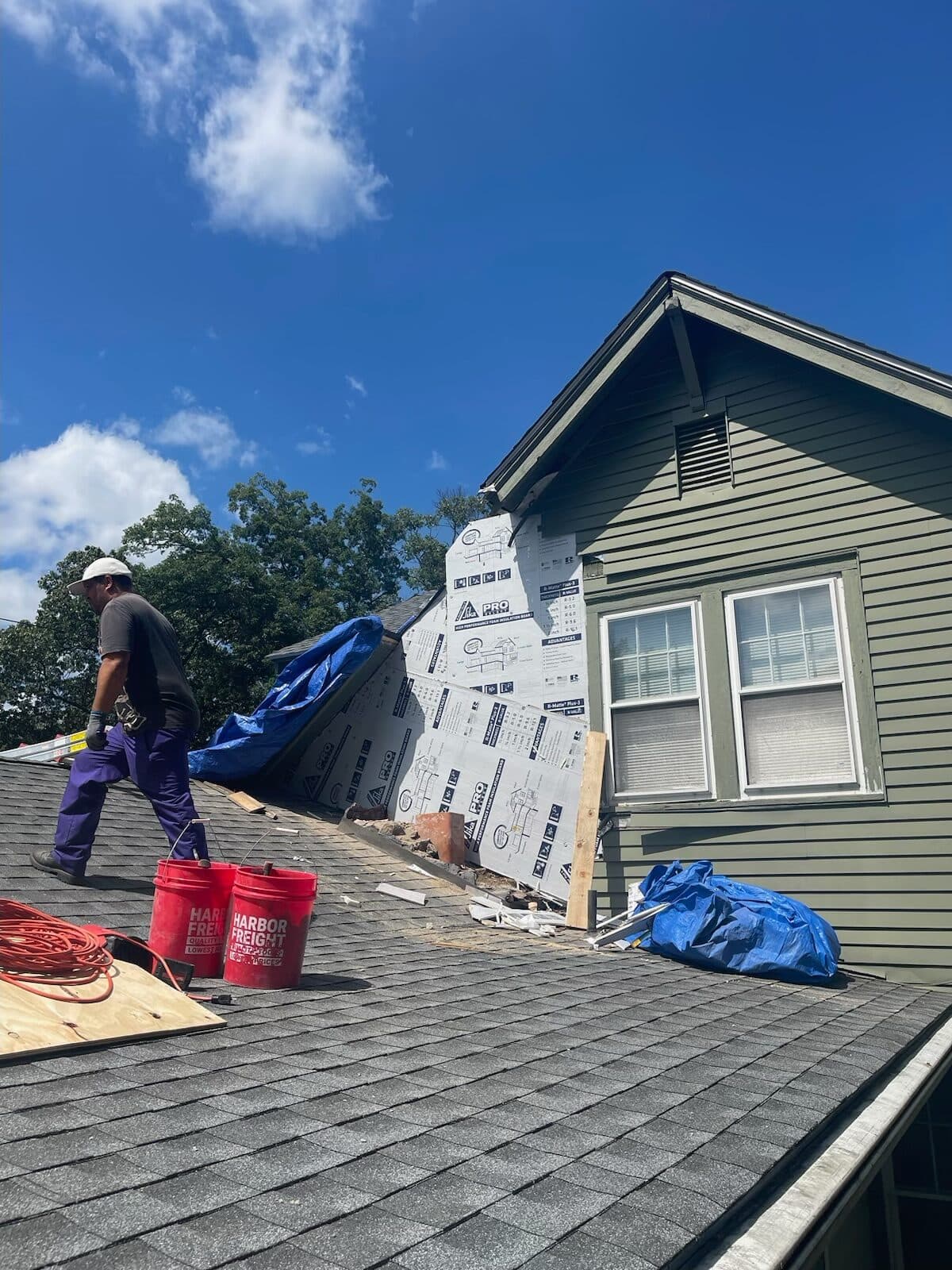
About Our Roof Repairs Service
From a single missing shingle to widespread storm damage, our crews respond fast and repair right the first time. We match shingle profiles, seal flashings properly, and back every repair with a written workmanship warranty. Same-day emergency tarping in Bergen, Passaic, Essex, Hudson, Morris and Union counties.
Why the Ceiling Stain Is Rarely Under the Leak
Water doesn't drip straight down. It gets in at a worn pipe boot or a lifted piece of flashing, lands on the roof deck or underlayment, and then runs along the deck, down a rafter, or across the top of the insulation until it finds a gap: a light fixture, a wall seam, a ceiling joint. By the time it stains drywall, it can be several feet from where it came in, sometimes in a different room. That's why we don't quote from the stain. We trace the leak from the attic first (dark or wet sheathing, stained rafters, matted insulation), and we rule out condensation, which shows as rusted nail tips across the whole deck rather than one wet spot, and then follow the water trail uphill to the entry point on the roof. We confirm the source, and check for a second one, before we price anything. A patch over the stain fixes nothing.
Can My Roof Be Repaired, or Does It Need Replacing?
Repair is the right call when the failure is localized and the rest of the roof is sound: a cracked pipe boot, a run of step flashing that has pulled away from the wall, a handful of wind-creased shingles on a roof that's mid-life. Replacement is the honest answer when the shingle field itself is giving out: granules piling up in the gutters, shingles that crack or crumble when you lift them, curling across whole slopes, or several unrelated leaks in different places. That last one is the pattern of three leaks in two years. Each patch holds, then the next failure shows up somewhere else, and you are paying repair prices for a roof that is finished. We inspect, photograph what we find, and tell you which side of the line your roof is on. If it's a repair, we repair it. If it's time to replace, see what a full roof replacement involves.
The Repairs We Do Most
- Leaking pipe boots, step flashing and valleys: roof leak repair
- Lifted, creased or missing shingles after wind: wind damage roof repair
- Winter water backing up under the eaves: ice dam removal
- Leaks around a skylight curb or frame: skylight service
- Chimney flashing, crown and cap: chimney servicing
Repairing Slate, Flat, Metal and Tile Roofs
Shingle repair habits don't carry over to other materials, and the wrong approach does damage. A slate roof can't be walked without breaking more slate, so a cracked slate is replaced individually, working from a hook ladder hung over the ridge rather than standing on the slate. A flat roof leaks at seams, parapet walls and drains far more often than in the middle of the field. Metal roofs fail at fasteners, panel seams and penetrations. Tile fails when tiles slip or crack and the underlayment beneath them takes the water. Each has its own page:
- Slate: individual slate replacement and flashing work on slate roofing
- Flat: seams, parapets and drains on flat roof repair
- Metal: fasteners, seams and penetrations on metal roofing
- Tile: slipped or cracked tile and underlayment on tile roofing
How Roof Repair Differs Across Our Six Core Counties
The same leak is a different job depending on the building stock and weather. Each county page goes into the detail:
- Bergen County: chimney flashing and ice dam leaks, plus the building-code and storm-insurance questions that come with repairs across 70 municipalities.
- Passaic County: flat-roof membranes on Paterson and Clifton multi-families, original slate on pre-1940 houses, and historic-district review on some Paterson streets.
- Hudson County: multi-family buildings, flat-roof membranes and waterfront exposure.
- Essex County: Newark, historic-district work in Montclair, and the western suburbs.
- Morris County: ice damming at higher elevation and historic-district review around Morristown.
- Union County: flat roofs and parapets on Elizabeth's row houses and triple-deckers, and slate and historic-district work in Westfield and Summit.
What You Get After a Repair
You get photos of the finished work next to what we found when we opened it up, so you can see what was wrong and what was done. The repair is covered by our written workmanship warranty, with the term written into your contract.
What's Included
- Same-day emergency response available
- Shingle, flashing, and underlayment repair
- Skylight and chimney flashing leaks
- Hail and wind damage restoration
- Written workmanship warranty
Roof Repairs — Common Questions
How much does a roof repair cost in New Jersey?
Roof repair pricing depends on scope. A single missing shingle fix is at the low end of the spectrum. A section repair with new flashing and underlayment is in the middle. Larger or multi-area repairs sometimes shift the math toward full replacement — we'll always show you both options with a written, itemized estimate so you can decide.
Can a roof repair fix a leak permanently?
Yes, when the leak source is localized — a single failed shingle, cracked flashing, or worn pipe boot. We repair, photograph the work, and back it with a written workmanship warranty. If you've had three separate leaks in two years, that's usually a sign the roof itself is at end-of-life and patching is throwing money at the problem.
Why does my roof only leak in certain storms?
Because water only gets in when the weather pushes it there. Wind-driven rain hits one slope at an angle and gets under flashing or lifted shingles that stay dry in a straight-down rain, so a leak can show up only in storms from one direction. Ice dams cause leaks only in freeze-thaw weeks, when meltwater backs up behind the frozen eave. And a gutter that overflows in heavy rain can push water back behind the fascia and up under the first course of shingles, which looks like a roof leak but isn't one. Note the date, the wind direction and the kind of weather when it happens; that narrows the search a lot.
Will my new shingles match my existing roof?
We bring samples and compare to your existing shingle line. Most major manufacturers (GAF, CertainTeed, IKO, Owens Corning, Tamko) have replacement matches for shingles less than 10 years old. Older roofs may require a closest-match approach where the repair patch is slightly visible but functional — we'll show you what to expect before we start.
Roof Repairs by Location
Dedicated roof repairs pages for the counties and cities where we do most of this work — written with local code, weather, and neighborhood context.
By County
By City